Use cases

One monitoring idea. Many real-world jobs.

Build your Pebble system Choose Eco 1, Eco 2, or Pebble Plus, then add the matching sensors and modules.
Pebble Eco and Pebble Eco 2 / Pebble Plus water tank monitoring installation beside a large outdoor storage tank
Eco / Plus

Water tanks

See the level trend before a refill, outage, or overflow becomes urgent.

Pebble Eco 2 / Pebble Plus monitoring pond and outdoor water assets with protected wiring and outdoor installation
Plus

Ponds and outdoor assets

Use protected wiring, proper strain relief, and a sensor choice matched to the environment.

Pebble Plus well monitoring application with submersible level sensor lowered into a stone well
Plus

Wells

Use submersible or compatible long-range sensor workflows when top-mounted ultrasonic is not the right geometry.

Pebble Eco aquarium monitoring application beside a glass fish tank
Eco

Aquariums

Compact monitoring for stable level awareness where mounting and sensor range are appropriate.

Pebble Plus pool level monitoring application installed near an outdoor swimming pool
Plus

Pools

Track level behavior in outdoor or semi-outdoor installations with the right enclosure, wiring, and sensor selection.

Pebble Eco 2 and Pebble Plus existing analog system integration in an industrial pump and piping environment
Plus

Existing analog systems

Bring compatible 0–5V, 0–10V, 0–20mA, or 4–20mA signals into the LumeLevel workflow through supported modules.

Pebble can be matched to different monitoring jobs by choosing the correct enclosure, sensor type, mounting method, wiring protection, and measurement workflow.

How LumeLevel monitoring works

The portal, hardware, sensor, and reported reading must describe the same real installation.

A Monitoring Profile is the portal record for the installation. The physical Pebble Monitor is linked to that record with the Link Code, and the tank record defines the tank geometry, reference values, and sensor type used to interpret the measurement.

  1. Prepare the Monitoring Profile and tank records for the physical site before device commissioning.
  2. Choose a sensor technology and range that match the real tank, fluid, mounting geometry, and Pebble model.
  3. Install the physical sensor so its mounting, wiring, orientation, and reference point match the portal configuration.
  4. Link the physical Pebble Monitor to the intended Monitoring Profile and configure the required network connection.
  5. Confirm the reported reading is reasonable, changes in the expected direction, has the expected timestamp, and appears on the intended tank before treating the installation as commissioned.

Monitoring principle: A plausible sensor reading is not enough by itself. The portal relationship, tank configuration, sensor type, physical installation, device link, network connection, and reported value must agree with one another.

Pebble sensor selection

Choose the Pebble that fits your tanks and installation.

Start with the number of tanks, then consider where the controller can be installed and which sensor will measure reliably.

Put your controller where it works best. Keep your sensors where they measure best.

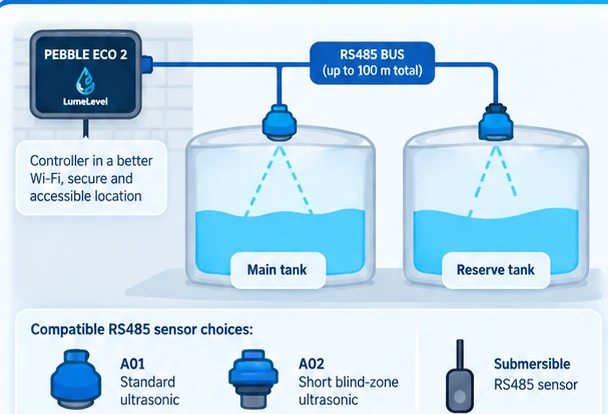
For ECO 2 and Pebble Plus, the supported RS485 trunk can reach up to 100 m in total, subject to the bus installation rules. Place the controller where Wi-Fi, security, and maintenance access are more suitable, while sensors stay at the tanks.
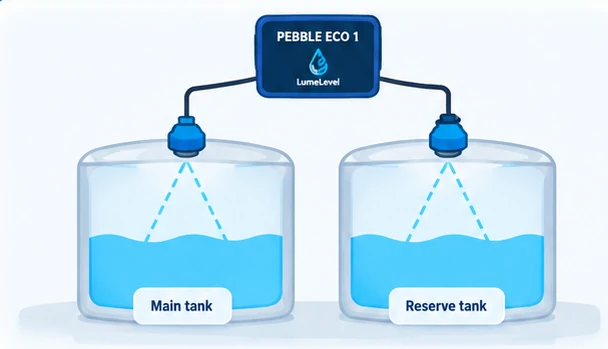
Pebble Eco 1
Pebble Eco 1

Simple direct ultrasonic

For a main tank and reserve tank when direct-connect ultrasonic sensors can be installed with a clear measuring path.
  • Two direct-connect ultrasonic sensor positions
  • Controller location is limited by the approved direct-sensor wiring arrangement
  • Best for straightforward installations with suitable ultrasonic clearance
Pebble Eco 2
Pebble Eco 2

Flexible two-tank RS485

For a main tank and reserve tank when you want more freedom to position the controller and select the sensor technology.
  • Two compatible RS485 sensor positions
  • Up to 100 m total RS485 trunk, subject to the approved bus installation rules
  • Choose A01, A02, or a compatible RS485 submersible sensor
  • Helps place the controller where Wi-Fi reception, security, and service access are better
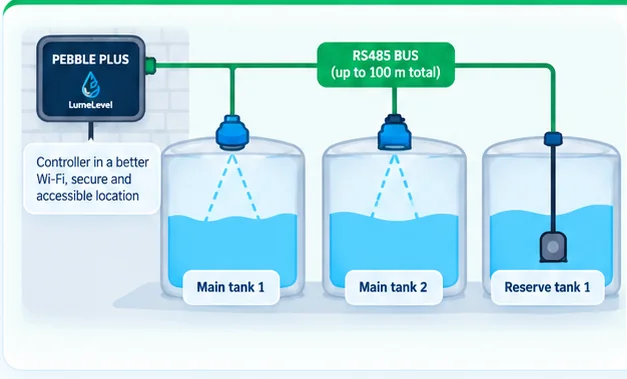
Example Pebble Plus RS485 installation showing three of up to six supported tank positions
Pebble Plus

Expanded multi-tank RS485

For larger sites that need the RS485 installation advantages of ECO 2 across more tank positions.
  • Up to 3 main tanks and 3 reserve tanks
  • Up to 100 m total RS485 trunk; this is not 100 m per sensor
  • Compatible RS485 ultrasonic and submersible sensor choices
  • Best when one controller must serve additional tank positions

Plan the sensor before you choose the controller location

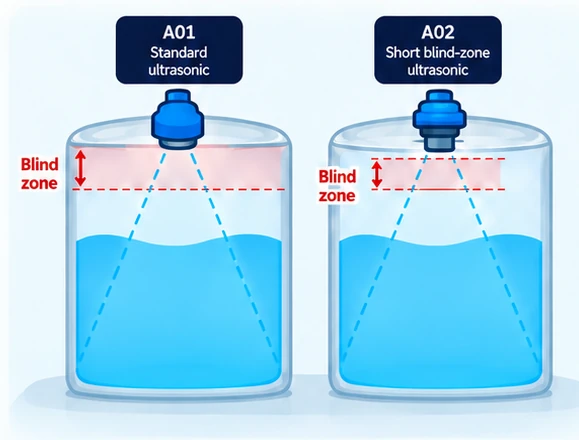
High water level

High water level

Check the sensor blind zone: the water must not rise too close to an ultrasonic sensor. A02 has a shorter near-sensor blind zone than A01 in the currently listed variants.
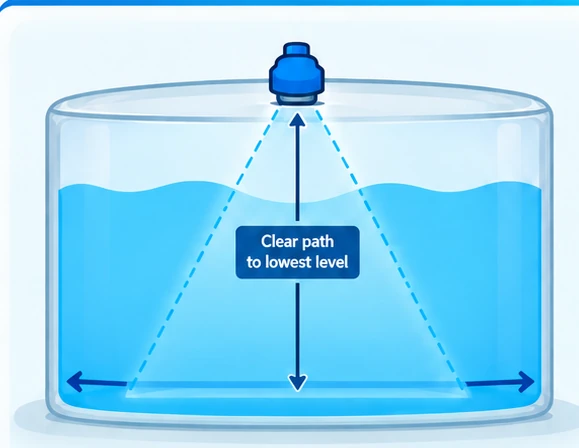
Tank depth and width

Tank depth and width

Ultrasonic beams spread as distance increases. Check for a clear path to the lowest expected water level without hitting walls, pipes, or bracing.
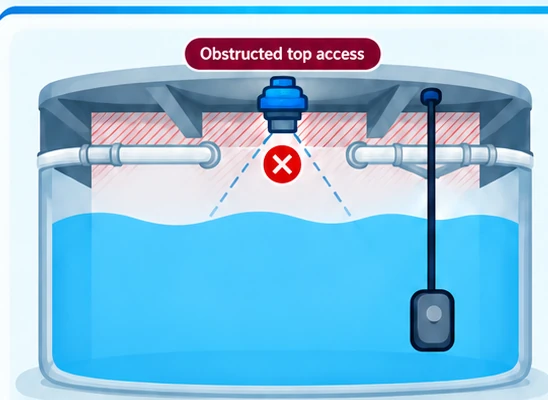
Obstructed or unsuitable top access

Obstructed or unsuitable top access

A compatible submersible pressure sensor can avoid ultrasonic beam and blind-zone limitations, but needs the correct range, cabling, and installation.

RS485 distance means the total supported bus trunk, not an individual allowance for every sensor. Follow the LumeLevel bus topology, short-drop, power, and termination requirements. Review device installation instructions

~~Blind Zone~~ PEBBLE ECO Top-mounted waterproof ultrasonic sensor
Eco 1 ultrasonic sensors

Waterproof ultrasonic

Use for simple non-contact level monitoring where the sensor is mounted above the tank and aimed directly at the water surface.

Typical measuring distance
Up to 20-600 cm, depending installation and installed environment.
Blind spot
About 20–25 cm near the sensor face
Tank Top Monitoring
Adds discrete tank-top monitoring so the system can know whether a tank lid/top has been opened or closed.
Best fit
Tanks with open headroom above the liquid
~~Blind Zone~~ RS485 BUS Short blind-zone RS485 ultrasonic option
Eco 2 + Plus sensor

Pebble-A02 RS485 ultrasonic

Use when you want non-contact ultrasonic sensing but need a much smaller near-sensor blind zone than the standard Eco ultrasonic option.

Typical measuring distance
About 3–450/500 cm depending on model
Blind spot
About 3 cm near the sensor face
Tank Top Monitoring
Optional via Pebble Tank Top Switch box.
Best fit
Lower-clearance tanks where the sensor sits closer to the full level
~~Blind Zone~~ RS485 BUS Longer-range RS485 ultrasonic option
Eco 2 + Plus sensor

Pebble-A01 RS485 ultrasonic

Use for larger tanks where a longer ultrasonic measuring range is more important than the smallest possible blind zone.

Typical measuring distance
About 28–750 cm depending installation and installed environment.
Blind spot
About 28 cm near the sensor face
Tank Top Monitoring
Optional via Pebble Tank Top Switch box.
Best fit
Taller tanks
RS485 BUS Submerged pressure-based level sensing
Eco 2 + Plus sensor

Pebble-300 submersible level sensor

Use when Mounting directly above the fluid is difficult or when a submerged pressure-based reading is preferred.
Typical measuring distance
Selected by sensor range, commonly 1 m to 20 m or more
Blind spot
No ultrasonic blind spot; sensor measures pressure from below the water surface
Tank Top Monitoring
Optional via Pebble Tank Top Switch box.
Best fit
Deep tanks, enclosed tops, turbulent top surfaces, or difficult ultrasonic geometry
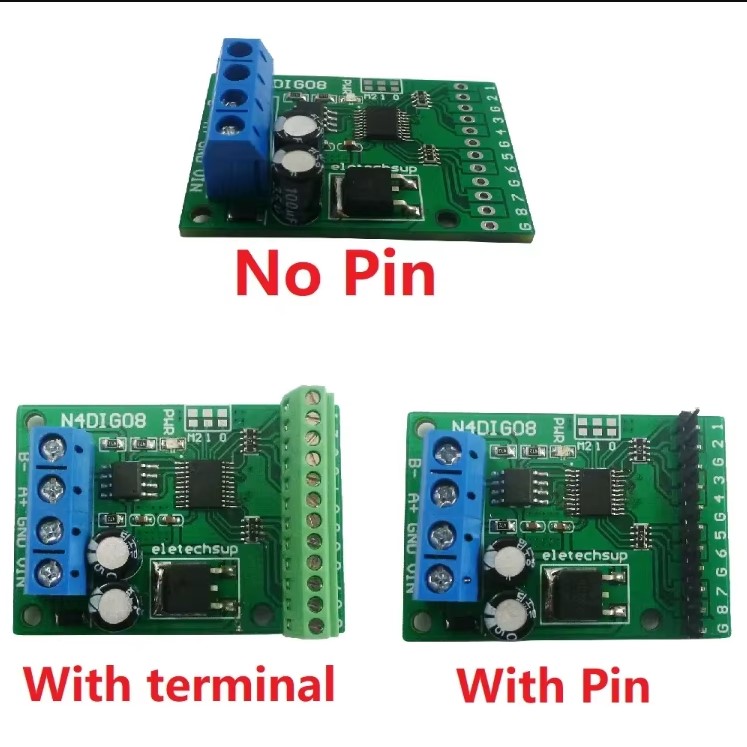
Pebble Tank Top Module for RS485 switch monitoring
Eco 2 + Plus module

Pebble Tank Top Module

Adds tank-top, dry-contact, and open/closed state monitoring to Eco 2 or Pebble Plus over the RS485 bus.
Best for
Lid-open alerts, tank access monitoring and alarm contacts
Connection
Switch inputs connect to the module; the module connects to the RS485 Pebble bus
Buyer note
Choose this when you need tank top monitoring in addition to level monitoring
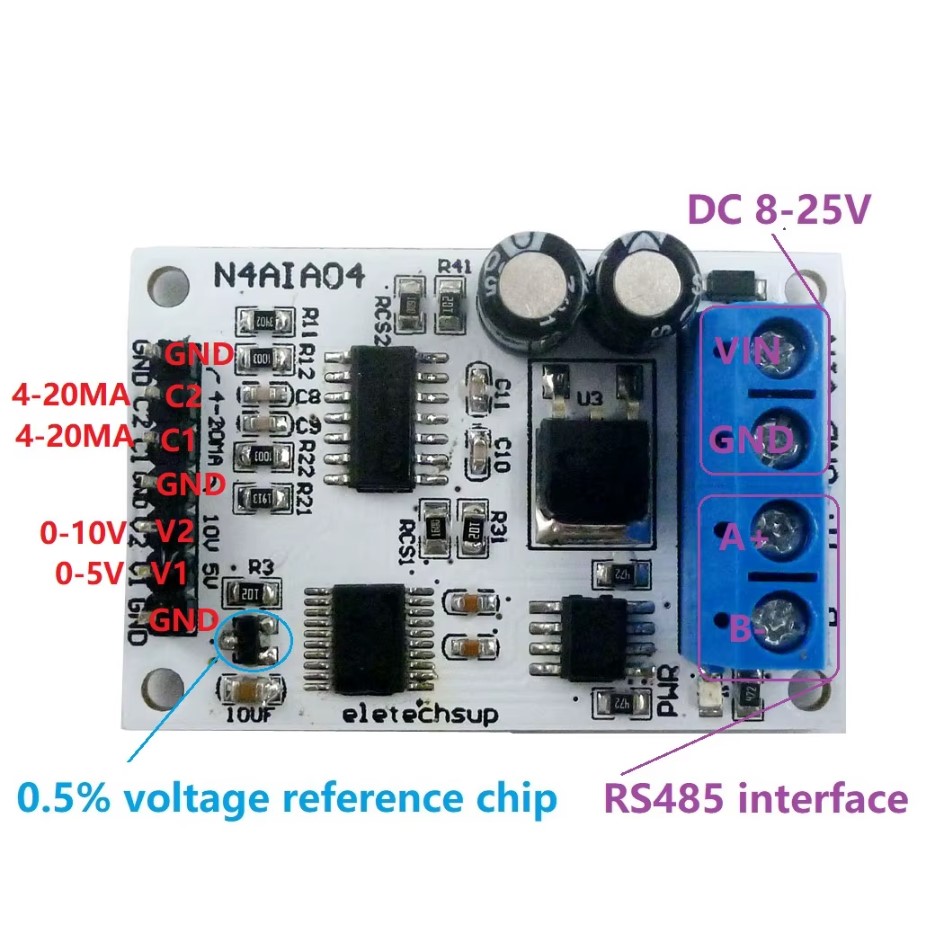
Pebble Analog Module for analog sensor integration
Eco 2 + Plus module

Pebble Analog Module

Connects compatible analog-output sensors to Eco 2 or Pebble Plus. Best for retrofit installations or existing industrial sensors that output voltage or current instead of native RS485.

Best for
Existing 4–20mA, 0–10V, and compatible analog level sensors
Connection
Analog sensor connects to the module; the module connects to the RS485 Pebble bus
Buyer note
For new installations, choose native RS485 when available; use analog for compatibility or retrofit needs

Simple selection guide

Choose ECO 1 for direct ultrasonic monitoring of a main and reserve tank. Choose ECO 2 for the same two-tank capacity with RS485 flexibility and controller-placement freedom. Choose Plus for up to six tank positions with the same RS485 advantages.

FAQ

Questions buyers and installers ask first

Which Pebble model should I choose?

Choose ECO 1 for direct ultrasonic monitoring of a main and reserve tank. Choose ECO 2 for the same two-tank capacity with RS485 flexibility and controller-placement freedom. Choose Plus for up to six tank positions with the same RS485 advantages.

Can Pebble monitor more than a basic water tank?

Yes. With the right model and sensor choice, Pebble can be positioned for tanks, aquariums, wells, ponds, pools, and compatible existing analog systems.

Can ECO 2 or Pebble Plus place the controller up to 100 metres from the sensors?

The supported RS485 trunk can run up to 100 metres in total when the approved installation rules are met. This is the total trunk length, not 100 metres per sensor.

What if my tank is narrow, deep, or obstructed?

Check both the ultrasonic blind zone and the beam clearance down to the lowest expected water level. Choose a suitable A01 or A02 variant, or a compatible submersible sensor when a clear ultrasonic path is not available.

Does sensor depth matter?

Yes. Measuring depth is sensor-specific. The selected ultrasonic, submersible, or analog transmitter range must match the actual installation depth and environment.

Can existing analog level sensors be reused?

In many cases, Pebble Eco 2 and Pebble Plus can integrate compatible analog signals through a supported RS485 analog acquisition module, after confirming the signal range and calibration points.

Pebble is the bridge between the tank and the decision.

Use Pebble Eco 1 when the two-tank install should stay direct-ultrasonic. Use Pebble Eco 2 when the two-tank install needs RS485 sensor choice. Use Pebble Plus when the job needs up to 6 tanks: 3 main + 3 reserve.